
Drivers and money
Which field values show up most among slow work, and how much money sits on the items involved. Both are patterns, not causes.
Use this when you want to know what the slow work has in common, and how much money is involved.
Drivers
Section titled “Drivers”A driver is a value that is much more common among slow items than among the rest. glasstarn checks this for you automatically.
How it works
Section titled “How it works”- glasstarn takes the slowest fifth of your work items.
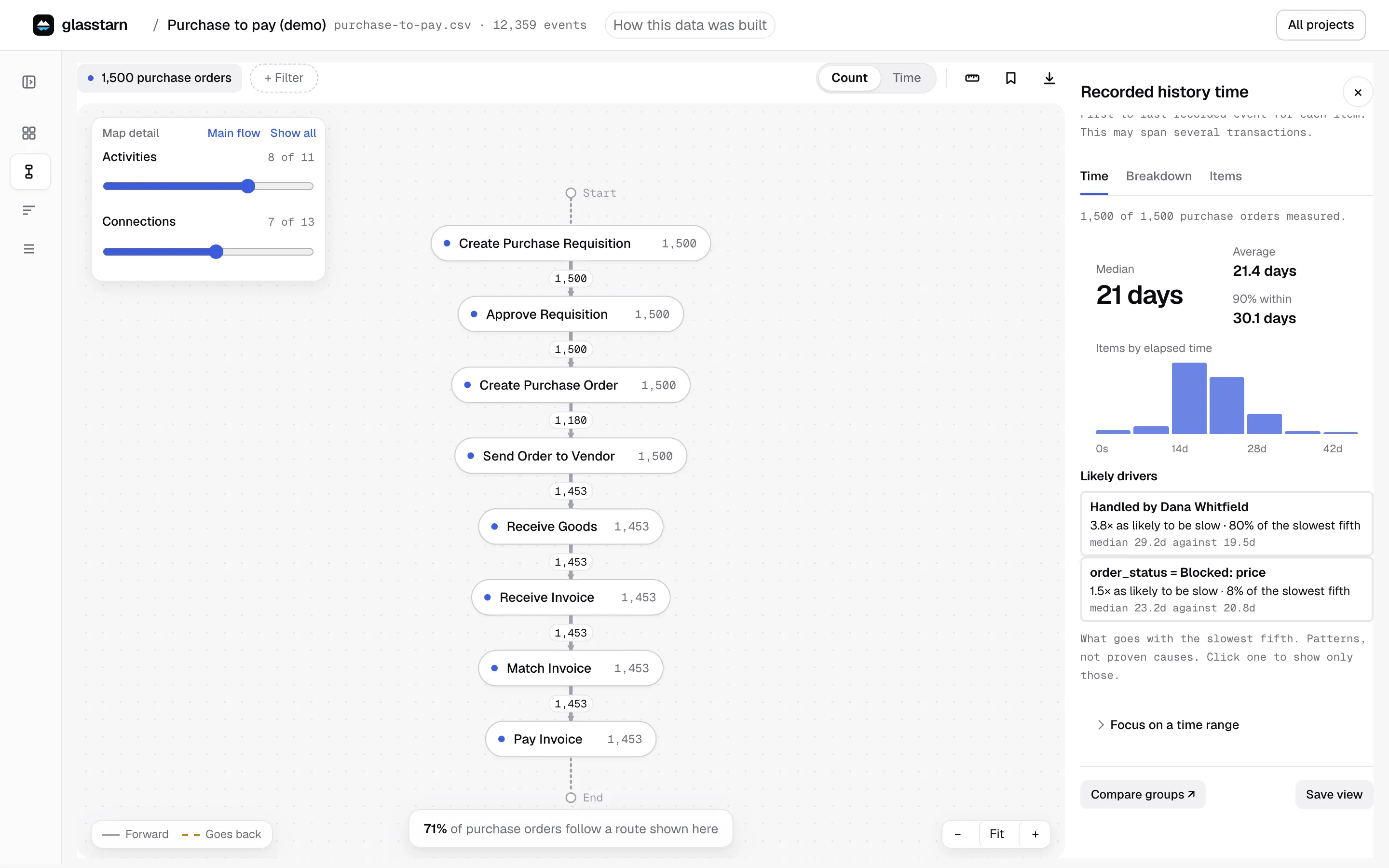
- For every extra column in your data (vendor, region, plant, document type, and so on) and for the person who handled the item, it compares how often each value appears in the slow fifth and in the rest.
- Values that stand out become findings.
Example: One vendor is on 31% of the slowest fifth of invoices, but only 6% of the rest.
Where you see them
Section titled “Where you see them”- On the Overview, as findings labelled Driver.
- In Measure, under Likely drivers, for the exact part of the process you are timing.
- From your agent: “What do the slowest orders have in common?”
What a driver is not
Section titled “What a driver is not”A driver is a pattern, not a cause. That vendor may send harder invoices, or their invoices may go to a busy team. Treat it as the next question to ask, not the answer. Your agent labels any explanation it offers as a guess.
You get better drivers when your export has more columns. See What your data needs.
If your data has an amount column, such as order value or invoice amount, glasstarn shows how much money is on the items in each finding.
- Findings say the items involved carry $2.4M. This is the value of those items, not a loss.
- Where the value sits on the Overview shows where that money is in the process, by last step.
- Step panels and Measure show the value on the items you are looking at.
Each item counts its amount once, however many steps it has.
Cost of delay
Section titled “Cost of delay”glasstarn does not invent a cost. If you want a cost of delay, give your agent a rate, for example “assume money costs 8% a year”. The agent then works it out from the engine’s numbers and shows the rate it used.